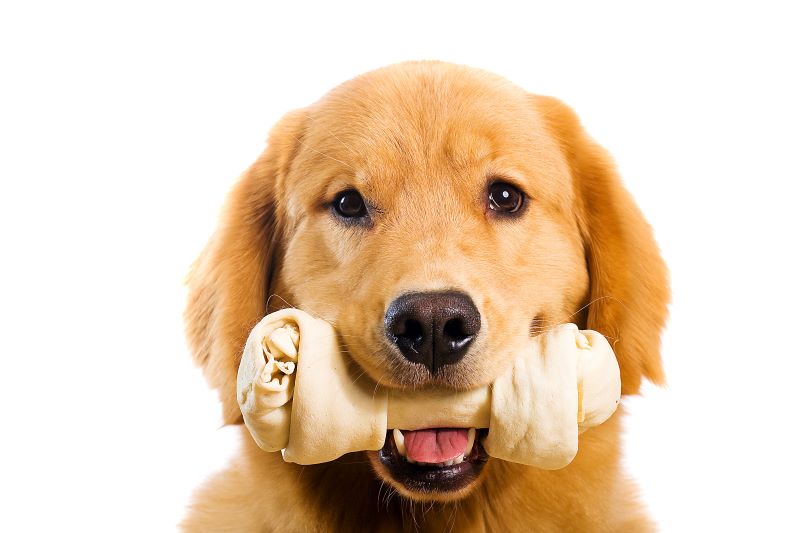
What is Rawhide?
Rawhide is made from the inner layer of an animal’s hide, most commonly from cows, but also sometimes from pigs or horses. The hide undergoes a process of cleaning, drying and treating with chemicals like lime and sulfur sulfide to remove fat and hair, and prevent spoilage and prepare it for shaping into various chew toys. To make them more appealing to dogs, some rawhide treats contain beef, chicken or liver flavourings.
What are the benefits of rawhide?
Although there are some benefits to giving your dog rawhide as a treat. For example, your dog can spend several hours every day chewing. Chewing can provide your dog with stimulation and help to relieve anxiety, keeping your dog’s joints strong, teeth clean and breath fresher. Dogs that chew regularly on bones or toys have less plaque and tartar buildup on their teeth.
The dangers of using rawhide dog treats
There are some big risks which can be serious to your dog. It can be life or death. The most common rawhide risks:
Contamination – As with pet toys, rawhide chews can contain trace amounts of toxic chemicals. As with other pet or human foods, Salmonella or E. Coli contamination is possible. Even humans can be at risk when in contact with these bacteria on rawhide treats.
Digestive Irritations – Some dogs are simply sensitive or allergic to rawhide or other substances used in their manufacture. This can cause problems, including diarrhoea and vomiting.
Choking or Blockages – Rawhides, bones, and other edible chews can pose a choking and blockage risk. In fact, this is a much greater risk than contamination or digestive irritation. If your dog swallows large pieces of rawhide, the rawhide can get stuck in their oesophagus or other parts of the digestive tract. Depending on its size and where it is located, a vet may be able to remove these peive farily easily through the throat with a procedure known as an endoscopy. But sometimes, abdominal surgery is needed to remove them from the stomach or intestines. If it isn’t resolved, a blockage can lead to death.
There is a list of safer chews that have more health benefits
Frozen Carrot – Freezing a carrot overnight will make the carrot last longer for your dog. But, it also contains high and thick nutrient value for your dog. Having the benefits of Fibre, Vitamins A and C, Potassium, and being a great source for your dog’s dental health.
Yak – Taks are long-lasting, natural and highly nutritious treats for your dog. These treat bars are hard, making them last longer for your dog. They are protein-rich chews to help improve your dog’s dental health by reducing plaque and tartar, which gives mental stimulation nd acts as a durable alternative to destructive chewing behaviour. Yak chews also come in various flavours, such as strawberry and mint.
Chicken Necks – Are a beneficial, nutrient-rich and dental cleaning treat for your dog. The nutritional value of chicken necks is high in protein, calcium, Vitamin B3, B6 and B12, Magnesium, Potassium and Zinc. But be careful with feeding your dog fresh raw chicken necks, as they can carry harmful bacteria like Campylobacter and neurological conditions like Polyradiculoneuritis (APN).
Beef Trachea – Beef Trachea, which is also known as “Windpipe”, is a great bone-free chew for dogs over 12 weeks old. The benefits of giving your dog a Trachea include supporting joints and bone health due to its high concentration of glucosamine and chondroitin, promoting dental hygiene by reducing plaque and tartar, providing a satisfying chew that relieves stress, and acting as a hypoallergenic, single-ingredient treat that is easily digestible for dogs with sensitivities.
Lamb Feet (Trotters) – Lamb Trotters are a long-lasting, high-protein, hypoallergenic chew that supports dental health through natural plaque removal, aids in muscle maintenance and offers natural sources of minerals and vitamins for one’s overall vitality.
Cow or Pig Ears – Providing protein, promoting dental health through chewing, supporting joint health with collagen and chondroitin and offering mental stimulation. Cow ears are generally a lower-fat, more digestible option than pig ears, which can be greasier. Cow ears with hair offer natural deodorising benefits, which are single-ingredient, air-dried treats with natural nutrients.
 Nicol's Cat & Dog Sitting Services
Leave a comment